How to Find a Missing Value in a Ratio: Easy Methods That Work
Learn how to find a missing value in a ratio using equivalent scale factors and cross multiplication. Master fraction conversions and problem checks.
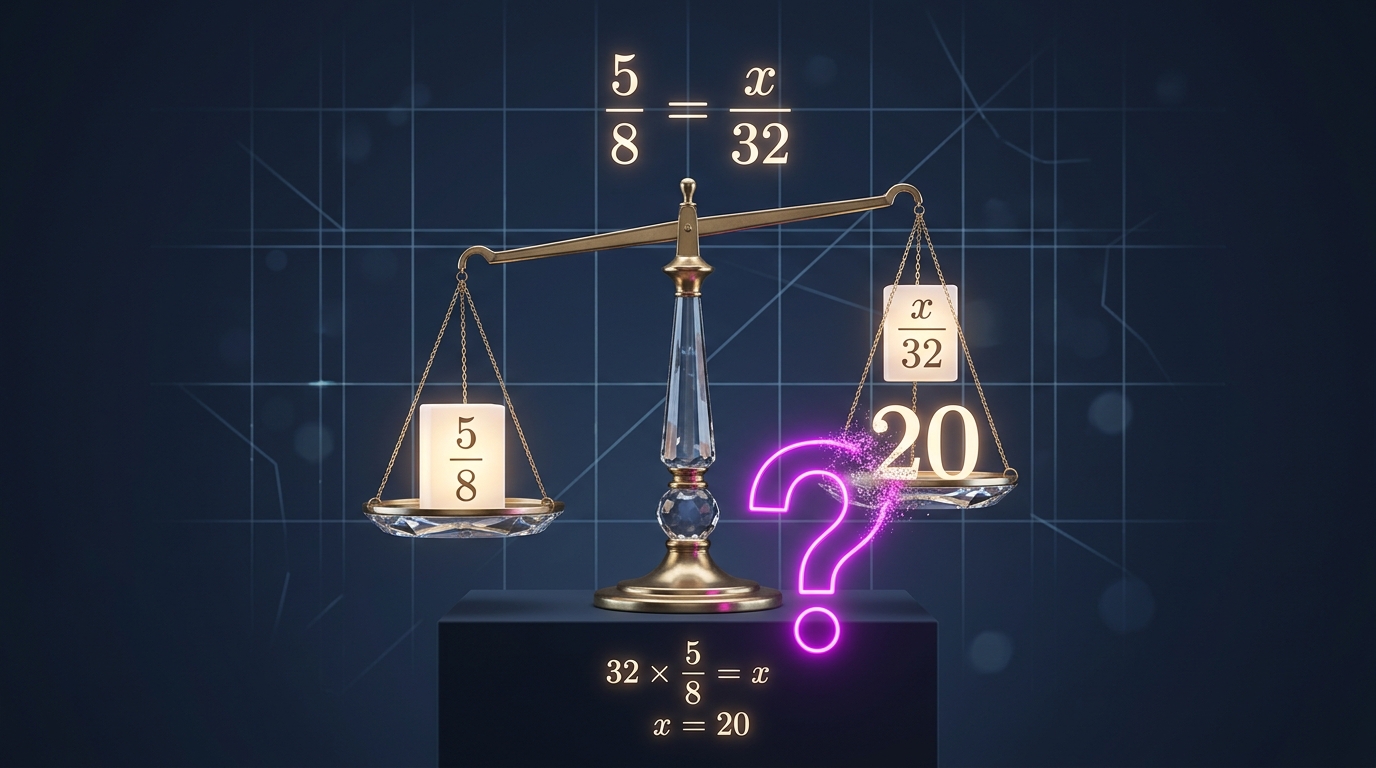
Sometimes a ratio has a blank. You know three numbers, but one is missing. Maybe it’s a recipe, a map, or a homework question. Good news: finding that number is easier than it looks. This guide shows how to find a missing value in a ratio using equivalent ratios and cross multiplication. You’ll also learn to handle decimals, fractions, and common setup mistakes.
What Does a Missing Value Represent in a Ratio?
A missing value is an unknown term in a pair of equal ratios. For example, 3:4 = x:20. Here, x is the number that keeps both ratios balanced.
Think of it as finding a matching piece. The first ratio sets the pattern. The second ratio must follow it. Your job is to find the unknown quantity that makes the pattern hold.
How Can You Use Equivalent Ratios to Find an Unknown Number?
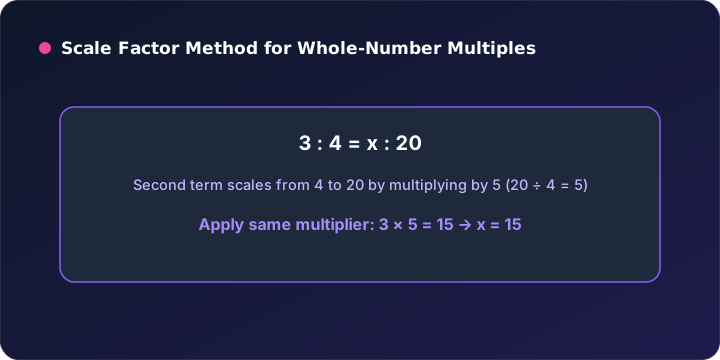
Compare the known terms. In 3:4 = x:20, the second terms are 4 and 20. Since 4 × 5 = 20, the scale factor is 5.
Now apply that factor to the first term. So 3 × 5 = 15. The missing value is 15. This method helps you find missing value using equivalent ratios without algebra.
When the Scale Factor Is a Whole Number
Whole-number factors make problems quick. If one term doubles, the other doubles too. Look for easy multiples first. This shortcut solves many ratio questions with unknowns in seconds.
How Does Cross Multiplication Help Solve a Missing Ratio Value?
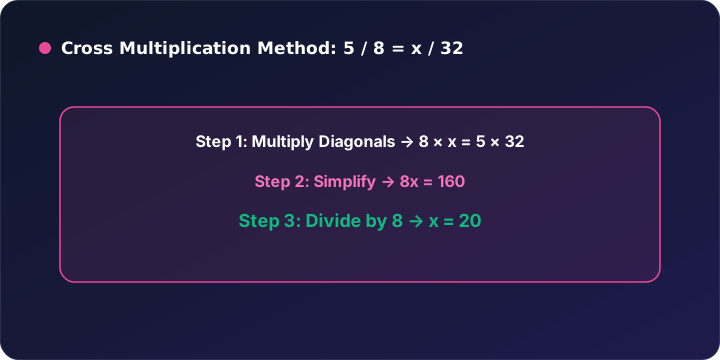
Write both ratios as fractions. So 3:4 = x:20 becomes 3/4 = x/20. Then multiply diagonally. That gives 4 × x = 3 × 20.
Now solve. Since 4x = 60, x equals 15. Cross multiplication works even when the scale factor isn’t obvious. It’s a reliable way to solve ratio equations of any size.
What Steps Can You Follow When One Ratio Term Is Unknown?
Follow the same routine each time. The table below shows the steps with an example.
| Step | Action | Example: 5:8 = x:32 |
|---|---|---|
| Write as fractions | Set up the proportion | 5/8 = x/32 |
| Cross multiply | Multiply diagonals | 8x = 160 |
| Divide | Isolate the unknown | x = 20 |
| Check | Plug the answer back in | 20/32 = 5/8 |
This routine helps you find missing ratio step by step without guessing.
How Do You Solve Missing Values in Ratios With Larger Numbers?
Simplify the known ratio first. Take 45:60 = x:84. Divide 45 and 60 by 15 to get 3:4. Now the problem becomes 3:4 = x:84.
Since 84 ÷ 4 = 21, each part is 21. So x = 3 × 21 = 63. Simplifying keeps big numbers friendly. It’s the best way to handle large ratios without a calculator.
How Can You Check the Unknown Value After Solving?
Plug your answer back into the ratio. Then simplify both sides. If they match, you’re correct. For 63:84, dividing by 21 gives 3:4. That matches.
You can also compare decimals. 63 ÷ 84 = 0.75, and 45 ÷ 60 = 0.75. Equal decimals confirm equal ratios. This quick ratio verification protects you from careless errors.
Using Decimals to Check a Missing Ratio Answer
Divide the first term by the second in each ratio. Matching results mean the answer works. This is a fast way to check a missing ratio answer on tests.
What Makes Some Missing-Ratio Problems More Difficult Than Others?
Some problems don’t have neat scale factors. Take 6:9 = 10:x. At first glance, 6 doesn’t go into 10 evenly. That throws many students off.
Simplify first. Since 6:9 reduces to 2:3, the problem becomes 2:3 = 10:x. Now 10 ÷ 2 = 5, so x = 15. Case study: Picture a student scaling a map where 6 inches equals 9 miles. She needs the miles for 10 inches. Simplifying reveals the answer: 15 miles.
How Should You Approach an Unknown Value When the Ratio Includes Decimals or Fractions?
Clear decimals by multiplying. Take 1.5:2 = x:8. Since 2 × 4 = 8, multiply 1.5 by 4. So x = 6. Cross multiplication also works: 2x = 12, so x = 6.
Fractions need one extra step. For 1/2 : 3/4 = x:9, multiply the first ratio by 4. That gives 2:3. Now 9 ÷ 3 = 3, so x = 6. This approach helps you solve ratio with fractions and decimals cleanly.
Turning Fraction Ratios Into Whole Numbers
Multiply both terms by the common denominator. The ratio stays equivalent. Whole numbers are easier to work with, so this step makes fraction ratios far less stressful.
What Errors Can Occur When Setting Up the Two Equivalent Ratios?
The biggest error is mismatched order. Suppose a class has 3 boys for every 4 girls, and there are 20 boys. Writing 3:4 = x:20 treats 20 as girls. That’s wrong. It should be 3:4 = 20:x.
Other errors include mixing units and flipping just one fraction. Label every term before you solve. Keep boys with boys and girls with girls. Clear labels prevent most setup mistakes.
Conclusion
Finding a missing ratio value takes a simple plan. Match the terms carefully, then use a scale factor or cross multiplication. Simplify big ratios first, and clear decimals or fractions when needed. Always plug your answer back in to confirm it. With practice, you’ll calculate unknown ratio value problems quickly and accurately.