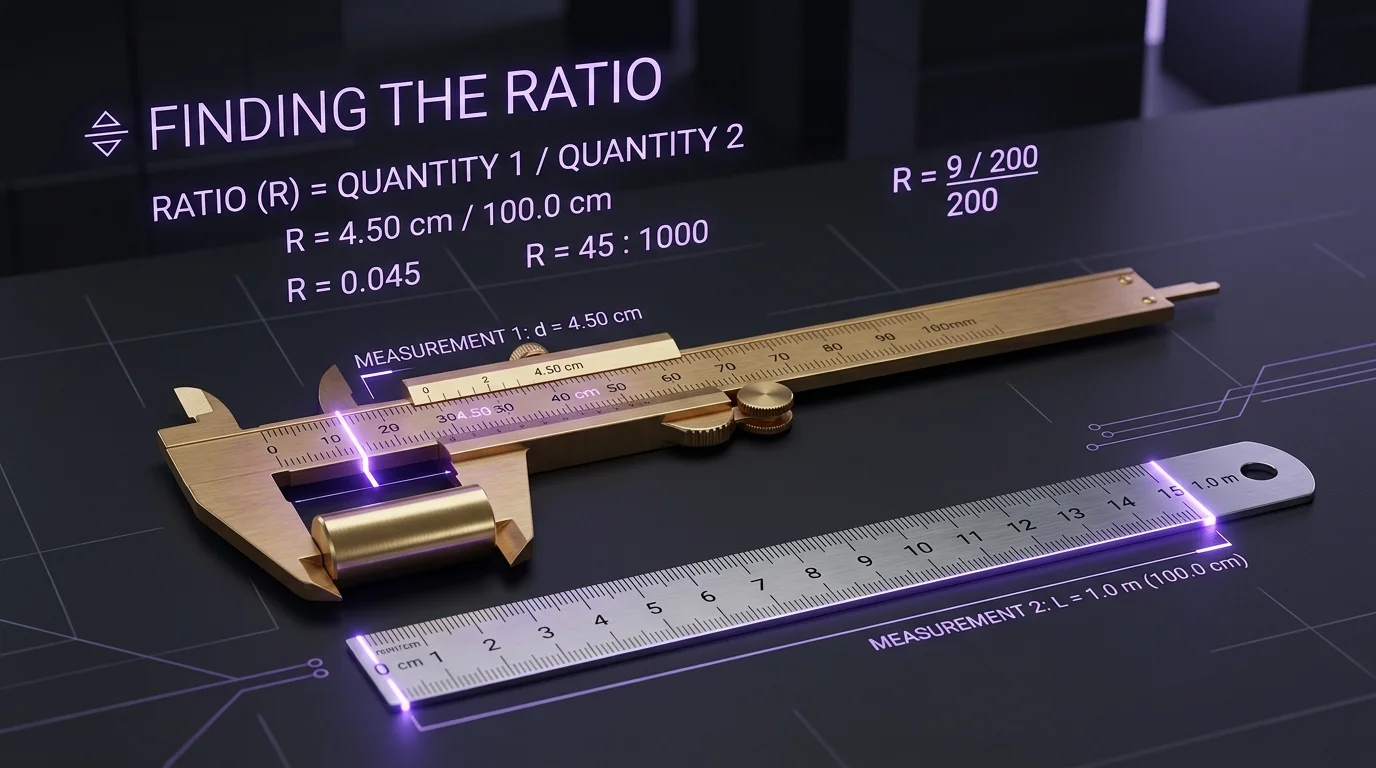
How to Find the Ratio Between Two Quantities
Learn how to find and write the ratio between two quantities. Master unit conversions, fraction adjustments, and GCF simplification.
A ratio calculator is a simple online tool that helps you compare two or more quantities and find missing values in a ratio. Instead of working out proportions by hand, you enter the numbers you know, and the calculator instantly gives you the answer.
A ratio is a way of comparing two or more quantities to show how much of one there is compared to another. It tells you the relationship between numbers rather than their actual size.
Ratios are usually written with a colon, like 2:3, but they can also be shown as a fraction (2/3) or with the word "to" (2 to 3). For example, if a class has 10 boys and 15 girls, the ratio of boys to girls is 10:15, which simplifies to 2:3. That means for every 2 boys, there are 3 girls.
The key idea is that ratios compare quantities of the same kind, and the order matters. Writing 2:3 is not the same as 3:2.
The basic formula for comparing two quantities is:
Here a is the first quantity and b is the second. Both must be in the same unit.
To simplify: divide both numbers by their greatest common factor.
Example: 12:18 ÷ 6 = 2:3
Proportion: when two ratios are equal → a : b = c : d, meaning a × d = b × c
Example: 3:4 = 9:x → 3x = 36 → x = 12
Ratio to percentage: (a ÷ b) × 100
Splitting a total by ratio: add the parts first, then multiply.
Example: $200 in a 3:2 ratio → 200 × 3/5 = $120 and 200 × 2/5 = $80
To use this Ratio Calculator, follow 3 steps:
Type the known ratio values into the input fields. Leave one field empty — that is the unknown value the Ratio Calculator solves.
Select the ratio mode — Solve, Simplify, or Scale. Each mode applies different equations to your input values.
Click Calculate. The result screen displays the answer with a visual ratio bar, pie chart, and step-by-step solution breakdown.
Using the ratio calculator takes just a few seconds.
The calculator also works for simplifying ratios — just enter two numbers, and it reduces them to their lowest terms using the greatest common factor.
Behind the calculator are a handful of core mathematical rules. Here are the ones used most often:
From that single identity, you can find any one variable if you have the other three:
Here are 3 example problems with step-by-step solutions using this Ratio Calculator:
A ratio scaling calculator lets you enlarge or reduce a ratio while keeping the proportion exactly the same. You change the size of the numbers, not the relationship between them.
An aspect ratio calculator works out the relationship between the width and height of an image, video, or screen — and helps you resize it without stretching or squashing the picture.
Aspect ratio describes the proportional relationship between width and height. It is widely used in photography, videography, monitors, and UI design.
A golden ratio calculator works out proportions based on the number phi (φ), which is approximately 1.618. It's used to divide a length into two parts that feel naturally balanced to the eye.
The golden ratio appears in architecture, art composition, logo design, and natural patterns (shell spirals, flower petals, leaf arrangements).
Converting a percentage into a ratio shows the same information in a different form. A percentage always compares something to 100, while a ratio compares quantities directly to each other. Both describe the same relationship — you're simply changing how it's expressed.
Equivalent ratios are different pairs of numbers that express the same relationship. Just as 1/2 and 2/4 are the same fraction, 1:2 and 2:4 are the same ratio.
A scale ratio calculator converts between the size of a model or drawing and the size of the real object it represents. It's the tool you need whenever something has to be shrunk down or blown up by a fixed factor.
Scale is written as model : real. A scale of 1:100 means one unit on the drawing equals 100 units in real life — so 1 cm on paper represents 1 metre on site.
A divide by ratio calculator splits a total amount into parts according to a given ratio. Instead of guessing or working through the fractions by hand, you enter the total and the ratio, and the tool returns each share.
Concrete Mix Ratios define the proportion of cement, sand, and gravel before mixing solutions. A standard concrete mix uses a 1 : 2 : 3 ratio — 1 part cement, 2 parts sand, 3 parts gravel. For 1 cubic meter (35.31 cubic feet) of standard concrete, this mix requires approximately 300 kilograms (661.39 pounds) of cement, 600 kg (1322.77 lbs) of sand, and 900 kg (1984.16 lbs) of gravel.
Scaling a recipe applies the Ratio Calculator to cooking. A cookie recipe calls for flour, sugar, and butter in a ratio of 3 : 2 : 1. When blending spices or adjusting portion counts, multiply each ingredient by the same scale factor to maintain the correct proportions.
A ratio and a fraction can express the same relationship, but they aren't always interchangeable. The difference comes down to what each one is comparing.
Converting a ratio to a fraction helps compare individual components against the total sum of all parts.
Explore our comprehensive collection of specialized ratio calculators across engineering, design, finance, and science.
Divide total monthly debt payments by gross monthly income and multiply by 100: DTI = (Monthly Debts ÷ Gross Income) × 100.
Divide both terms by their greatest common factor (GCF) to reduce the ratio to its simplest form.
Divide your total cholesterol by your HDL cholesterol: Cholesterol Ratio = Total Cholesterol ÷ HDL.
Divide your body fat mass by your total body weight and multiply by 100: Body Fat % = (Fat Mass ÷ Total Weight) × 100.
Divide the loan amount by the appraised property value and multiply by 100: LTV = (Loan Amount ÷ Appraised Value) × 100.
Divide net operating income by total debt service: DSCR = Net Operating Income ÷ Total Debt Service.
Divide the number of teeth on the driven gear by the number of teeth on the driving gear: Gear Ratio = Driven Teeth ÷ Driving Teeth.
Master proportions, scaling, conversions, and real-world math applications with our practical step-by-step guides.
Learn how to find and write the ratio between two quantities. Master unit conversions, fraction adjustments, and GCF simplification.

Practice ratio word problems with fully worked answers, sum checks, simplification tests, and multi-ratio connection strategies.
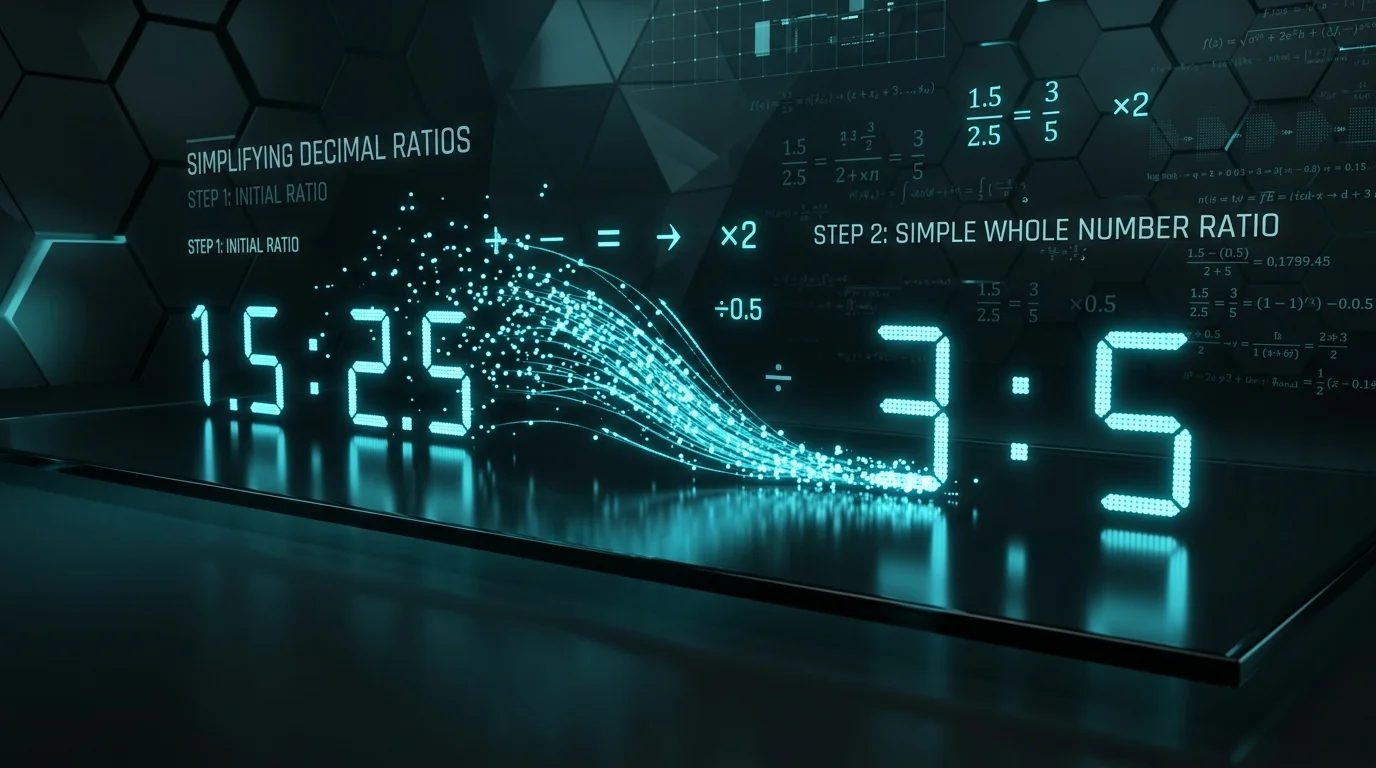
Simplify decimal ratios in two easy steps. Learn how to remove decimal points with powers of 10 and reduce whole numbers with GCF.