How to Divide an Amount in a Given Ratio: A Simple Step-by-Step Guide
Learn how to divide an amount in a ratio using one simple method. Master counting parts, finding unit value, and verifying fair shares.

Splitting money sounds easy until the shares aren’t equal. Maybe two friends invested different amounts. Maybe a prize must go 2 to 3. That’s where ratio division comes in. This guide shows you how to divide an amount in a ratio using one simple method. You’ll learn to count parts, find one part, and check every share. By the end, uneven splits will feel as easy as cutting a pizza.
What Does It Mean to Divide an Amount in a Given Ratio?
A ratio tells you how a total should be shared. If the ratio is 2:3, the first person gets 2 parts for every 3 parts the second person gets. The shares aren’t equal, but they stay fair. This is the heart of proportional sharing.
Think of it like slicing a cake into equal pieces. Then you hand out those pieces in the right amounts. The pieces are all the same size. Only the number of pieces changes. That’s all ratio sharing really means.
How Do You Calculate the Total Number of Ratio Parts?
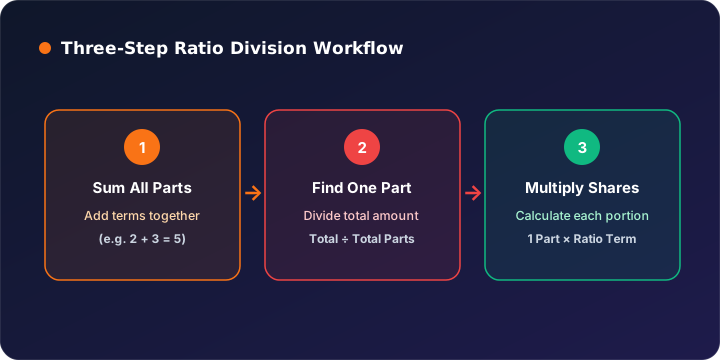
Add up the numbers in the ratio. For 3:5, you get 3 + 5 = 8 parts. For 2:3:5, you get 10 parts. This sum is called the total ratio parts.
Why does this matter? The total tells you how many equal pieces to cut. Skip this step, and every share will be wrong. So always start here before you touch the amount.
Finding Total Ratio Parts for Three or More People
The rule never changes, no matter how many people share. Just add every term together. A ratio of 1:2:3:4 has 10 parts. Once you have that number, you’re ready to calculate parts of a ratio for everyone involved.
How Can You Find the Value of One Ratio Part?
Divide the total amount by the number of parts. If you’re sharing $120 in the ratio 3:5, divide $120 by 8. One part equals $15. This single number unlocks the whole problem.
Here’s the simple ratio division formula. Value of one part equals the total amount divided by the total parts. Once you find the value of one ratio part, every share takes just one quick multiplication.
How Do You Divide an Amount Between Two or More People?
Multiply each ratio number by the value of one part. For $120 in 3:5, the first share is 3 × $15 = $45. The second share is 5 × $15 = $75. That’s how you divide an amount between two people.
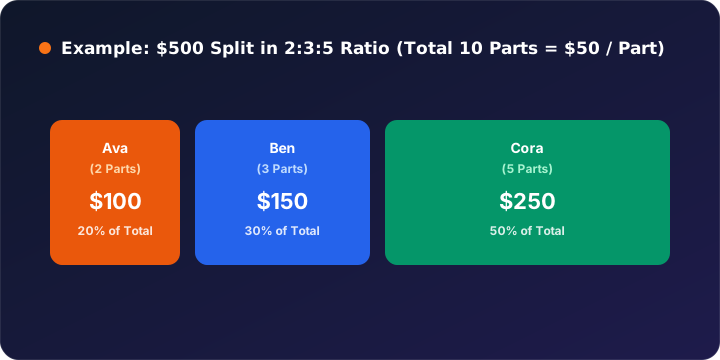
The same steps work for larger groups. The table below shows $500 split in the ratio 2:3:5.
| Person | Ratio Parts | Calculation | Share |
|---|---|---|---|
| Ava | 2 | 2 × $50 | $100 |
| Ben | 3 | 3 × $50 | $150 |
| Cora | 5 | 5 × $50 | $250 |
| Total | 10 | $500 ÷ 10 = $50 per part | $500 |
How Can You Check Each Share After Dividing the Amount?
Add all the shares together. They must equal the original amount. In the example above, $100 + $150 + $250 = $500. If the sum is off, something went wrong.
Next, check the ratio itself. Divide each share by the value of one part. You should get the original ratio numbers back. This quick ratio verification takes seconds and catches most slips before they cause trouble.
A Fast Way to Check Your Ratio Division Answer
Try simplifying your shares. $45 and $75 both divide by 15, giving 3:5. That matches the starting ratio perfectly. This trick helps you check ratio division answer results without redoing the whole problem.
How Does Ratio Division Work With Money and Measurements?
Money is the most common use. Business partners use a profit sharing ratio. Families use an inheritance ratio. Contest organizers use one for prize distribution. The steps stay exactly the same each time.
Measurements work the same way. Say you cut a 3.6-meter ribbon in the ratio 1:2. That’s 3 parts, so each part is 1.2 meters. The pieces are 1.2 meters and 2.4 meters. Case study: Picture two roommates splitting $1,500 in rent by room size, 2:3. Each part is $300, so they pay $600 and $900.
What Mistakes Can Lead to Incorrect Ratio Shares?
The biggest mistake is dividing by the wrong number. Some students divide $120 by 3 instead of by 8. That gives shares that don’t add up. Always divide by the total parts, not by one term.
Another slip is mixing up the order. If Sam gets the first term, keep Sam first. Swapping names flips the shares. Finally, watch your units. Don’t split 2 meters as if it were 200 centimeters halfway through.
How Should You Handle Ratios With Large or Unequal Parts?
Simplify the ratio first. A ratio like 125:375 looks scary. But both numbers divide by 125, leaving 1:3. Now the math is much friendlier.
Very unequal ratios need extra care. A 1:19 split gives one person just 5% of the total. Double-check that tiny share, since small errors stand out there. This habit helps you calculate unequal ratio shares and divide large amounts using ratios with confidence.
What Happens When the Total Amount Is Not Easily Divisible by the Ratio?
Sometimes one part isn’t a neat number. Split $100 in the ratio 1:2, and one part equals $33.333… You’ll need to round. The shares become $33.33 and $66.67, which still add to $100.
Rounding can leave a stray penny. Split $100 three ways at 1:1:1, and you get $33.33 each. That’s only $99.99. Decide who gets the extra cent, and keep the rule fair. Writing that choice down avoids arguments later.
Rounding Shares Without Losing the Total
Round every share except the last one. Then subtract those rounded shares from the total. The last person gets whatever remains. This simple method keeps your ratio distribution accurate to the penny.
Conclusion
Dividing an amount by a ratio takes just three moves. Add the parts, find one part, and multiply. Then check that the shares add up and still match the ratio. Simplify big ratios first, and round carefully when numbers get messy. With practice, you’ll split a total in a ratio quickly, whether you’re sharing money, ribbon, or rent.