How to Find the Ratio Between Two Quantities: A Simple Guide
Learn how to find and write the ratio between two quantities. Master unit conversions, fraction adjustments, and GCF simplification.
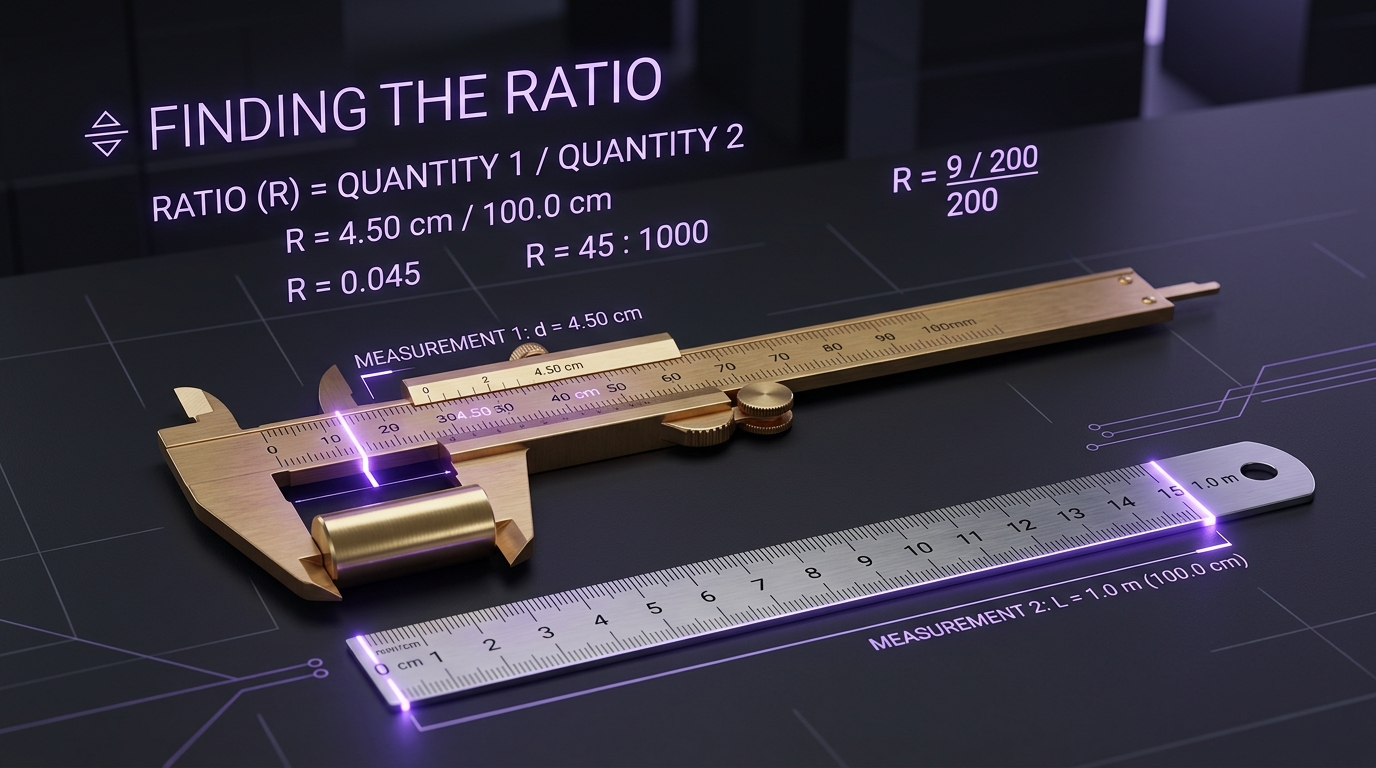
Ratios help you compare things quickly. How much taller is one plant than another? How does one price compare with another? A ratio answers that in a neat, simple form. This guide shows how to find the ratio between two quantities step by step. You’ll learn to handle units, decimals, and fractions, and to avoid common slips.
What Information Do You Need to Find a Ratio Between Two Quantities?
You need two values and their units. You also need to know the order. “Apples to oranges” isn’t the same as “oranges to apples.”
The units matter more than people expect. Both quantities must use the same unit before you compare them. With those three pieces in place, you can calculate the ratio of two quantities with confidence.
How Do You Write Two Given Quantities as a Ratio?
Place the first quantity before the colon and the second after it. If a class has 12 girls and 18 boys, the ratio of girls to boys is 12:18.
You can also write it as “12 to 18” or as the fraction 12/18. All three forms mean the same thing. Choose the one your teacher or task prefers. This is how you write two quantities as a ratio clearly.
Keeping the Order of a Ratio Correct
Follow the wording exactly. If the question says “boys to girls,” put boys first. A reversed ratio describes a different relationship. This simple rule protects every ratio calculation.
What Is the Best Way to Compare Quantities With Different Units?
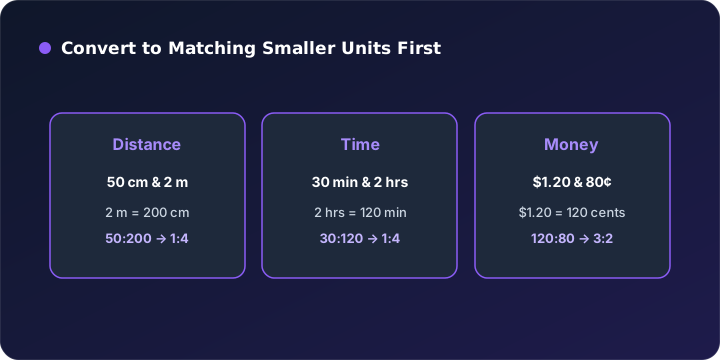
Convert one quantity so both share a unit. Compare 50 centimeters to 2 meters by changing 2 meters into 200 centimeters. Now the ratio is 50:200.
Pick the smaller unit when possible. It usually avoids decimals. The table below shows common conversions.
| Quantities | Convert To | Ratio | Simplest Form |
|---|---|---|---|
| 50 cm and 2 m | Centimeters | 50:200 | 1:4 |
| 30 minutes and 2 hours | Minutes | 30:120 | 1:4 |
| 8 ounces and 2 pounds | Ounces | 8:32 | 1:4 |
| $1.20 and 80 cents | Cents | 120:80 | 3:2 |
How Can You Reduce a Calculated Ratio to Its Simplest Form?
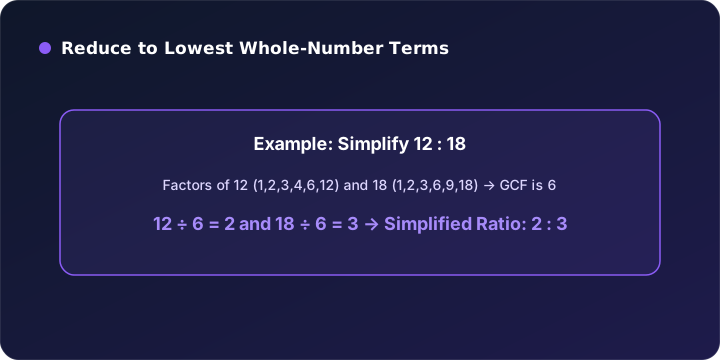
Divide both terms by their greatest common factor. For 12:18, the GCF is 6. Dividing gives 2:3.
A simplified ratio is easier to read and compare. It also shows the relationship clearly. When no number other than 1 divides both terms, you’re finished. That’s how you calculate the simplest ratio every time.
What Happens When the Two Quantities Are Decimals or Fractions?
Turn decimals into whole numbers first. Compare 2.4 kg to 3.6 kg by multiplying both by 10. That gives 24:36, which simplifies to 2:3.
Fractions need a common multiplier. Compare 1/2 to 3/4 by multiplying both by 4. That gives 2:3. These steps help you calculate ratio with decimals and fractions without stress.
How Do You Interpret the Meaning of a Ratio Between Two Values?
A ratio of 2:3 means for every 2 of the first, there are 3 of the second. It also means the first is two-thirds the size of the second.
Interpreting ratios helps in daily choices. Case study: Picture a shopper comparing two cereal boxes. One weighs 12 ounces, and the other weighs 18 ounces. The 2:3 ratio shows the larger box holds 50% more. Now she can compare prices smartly.
Turning a Ratio Into a Meaningful Statement
Say the ratio out loud in words. “For every 2 girls, there are 3 boys.” This habit builds strong ratio interpretation skills and makes answers easier to explain.
What Mistakes Can Lead to Incorrect Ratio Shares?
Reversing the order is the most common mistake. Another is comparing values in different units. A ratio of 50:2 for centimeters and meters is badly misleading.
Some students also compare part to whole by accident. If 12 of 30 students are girls, girls to boys is 12:18, not 12:30. Finally, forgetting to simplify leaves answers harder to read. Label, convert, and reduce to stay safe.
How Should You Calculate a Ratio When the Measurements Use Different Units?
Mixed units within one measurement need extra care. Compare 1 hour 30 minutes to 45 minutes. First, change 1 hour 30 minutes into 90 minutes. The ratio becomes 90:45, which simplifies to 2:1.
Money works the same way. Change dollars to cents before comparing. Weight and volume follow this rule too. Always turn every part into one unit. This helps you find ratio when units are different without errors.
Checking Unit Conversions Before You Compare
Double-check each conversion. One hour is 60 minutes, and one pound is 16 ounces. A single wrong conversion changes the whole ratio. A quick check keeps your measurement ratio reliable.
What Should You Do When the Given Quantities Are Not Whole Numbers?
Mixed numbers need converting first. Compare 1 1/2 to 2 1/4 by changing them into fractions: 3/2 and 9/4. Multiply both by 4 to get 6:9. That simplifies to 2:3.
Repeating decimals are trickier. A value like 0.333… is really 1/3. Use the fraction instead of a rounded decimal. That keeps your ratio exact. Precision matters, especially in science and cooking.
Conclusion
Finding a ratio between two quantities takes a few careful steps. Write the values in the right order, convert them to the same unit, and remove any decimals or fractions. Then simplify by dividing by the greatest common factor. Finally, say the ratio in words to check its meaning. With this routine, you can calculate and simplify a ratio accurately in any situation.