How to Scale a Recipe Up or Down Using Ratios (With Real Examples)
Scale any recipe up or down with ratio math. Learn scaling factor calculations, awkward measurement adjustments, and pan size tips.
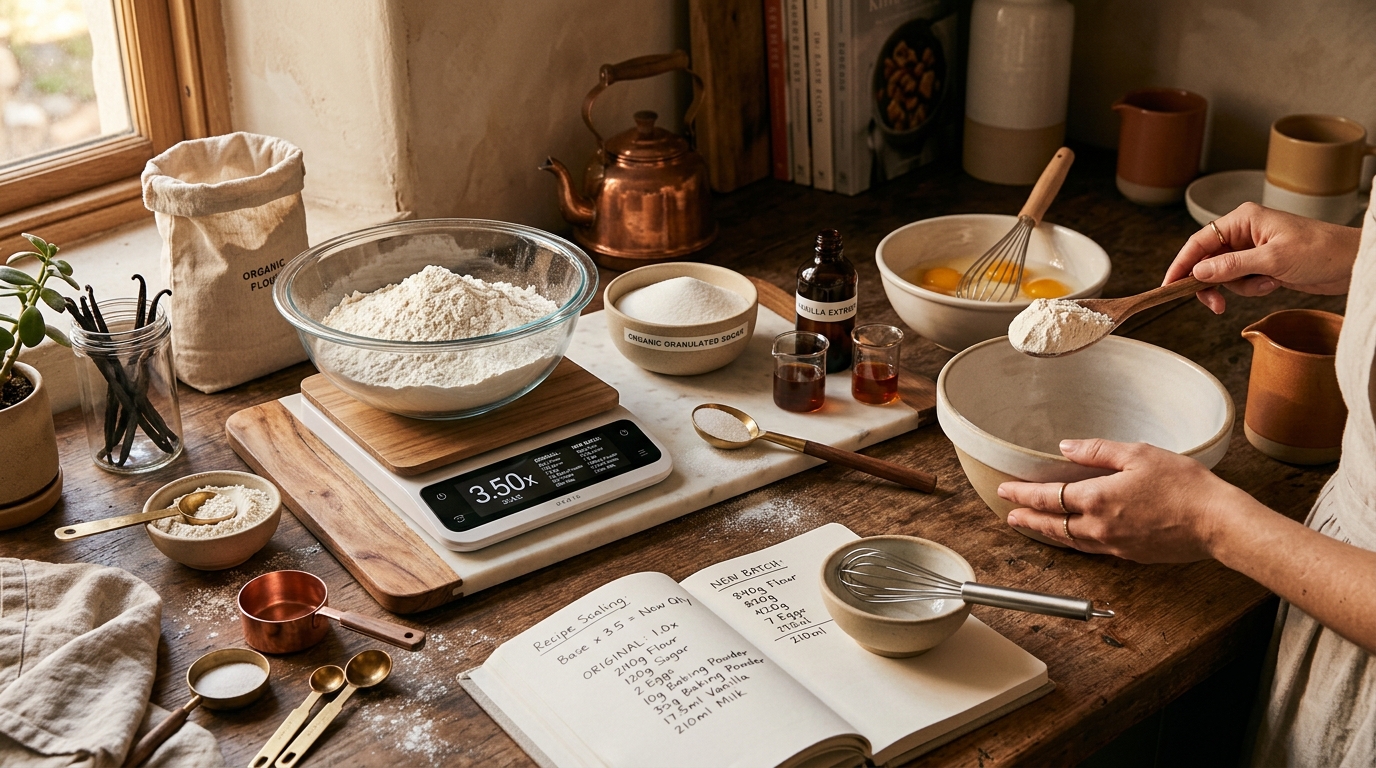
Your favorite recipe feeds four. Tonight, you’re cooking for six. Or maybe you just want a small batch for yourself. Either way, guessing can ruin the dish. Recipe scaling with ratios keeps every flavor balanced. This guide shows you how to scale a recipe using ratios, how to handle odd measurements, and which ingredients need extra care. Let’s get cooking.
What Does Recipe Scaling Mean When Using Ratios?
Scaling means changing the batch size while keeping the same balance. A cake with 2 cups flour and 1 cup sugar has a 2:1 ratio. Whether you bake one cake or three, that ratio must stay the same.
Think of it like zooming a photo. The picture gets bigger or smaller, but its shape doesn’t change. Recipe proportions work the same way. Every ingredient grows or shrinks together.
How Do You Increase Ingredient Amounts for More Servings?
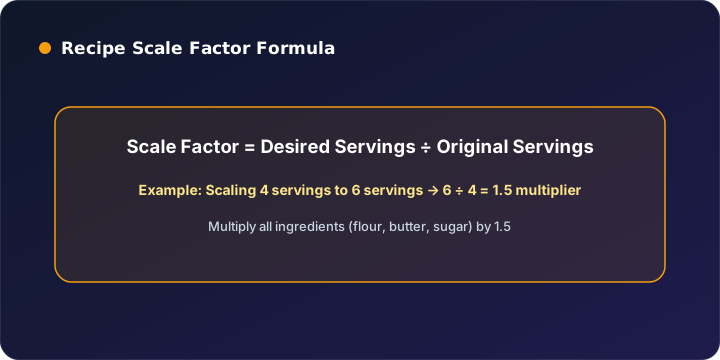
Multiply each ingredient by the same number. That number is your scaling factor. To go from 4 servings to 6, multiply everything by 1.5.
Here’s how that looks in practice. The table shows a cookie recipe scaled up.
| Ingredient | Original (4 servings) | Scaled (6 servings) |
|---|---|---|
| Flour | 2 cups | 3 cups |
| Sugar | 1/2 cup | 3/4 cup |
| Butter | 1/3 cup | 1/2 cup |
| Vanilla | 1 teaspoon | 1 1/2 teaspoons |
| Eggs | 2 | 3 |
This is how you calculate ingredient amounts for more servings without guessing.
How Can You Reduce a Recipe Without Changing Its Proportions?
Use a scaling factor smaller than 1. To cut 12 servings down to 6, multiply by 0.5. That’s the same as halving everything.
Be consistent. If you halve the flour, halve the sugar, salt, and liquid too. Shrinking only some ingredients breaks the balance. That’s the simple secret to scale a recipe down successfully.
How to Halve a Recipe Using Ratios
Halving is the easiest reduction. Divide every amount by 2. One cup becomes 1/2 cup. Two eggs become one. This method helps you halve a recipe using ratios for smaller households.
How Do You Find the Scaling Factor for a Recipe?
Divide the servings you want by the servings the recipe makes. Want 10 servings from a recipe for 4? That’s 10 ÷ 4 = 2.5. Every ingredient gets multiplied by 2.5.
This simple recipe scaling formula works both ways. Want 3 servings from a recipe for 12? That’s 3 ÷ 12 = 0.25. So you’d use a quarter of each amount. Write the factor at the top of your recipe card.
What Happens When Ingredient Measurements Use Different Units?
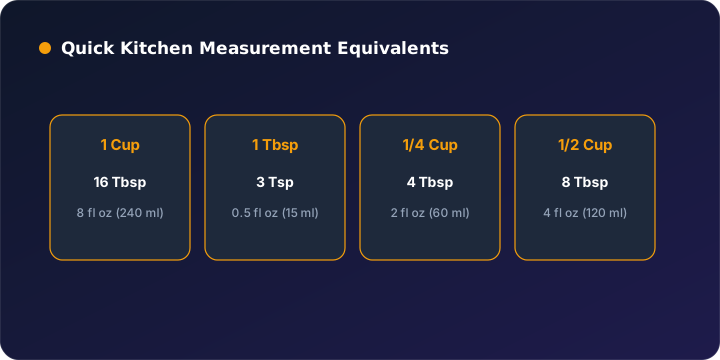
Recipes often mix cups, tablespoons, and teaspoons. When scaling, convert to one unit if the math gets messy. The table below shows common US kitchen conversions.
| Unit | Equals |
|---|---|
| 1 cup | 16 tablespoons |
| 1 tablespoon | 3 teaspoons |
| 1 cup | 8 fluid ounces |
| 1/4 cup | 4 tablespoons |
For example, 1/4 cup scaled by 0.25 is 1 tablespoon. That’s much easier to measure. Smart recipe measurement conversion saves time and reduces waste.
How Can Ratios Keep Ingredient Proportions Consistent?
Many cooks memorize cooking ratios. A classic vinaigrette uses 3 parts oil to 1 part vinegar. Plain rice often uses about 2 parts water to 1 part rice. These ratios work at any size.
Case study: Picture a parent making cookies for a class party. The recipe makes 24 cookies, but she needs 60. Her factor is 60 ÷ 24 = 2.5. She multiplies each ingredient by 2.5, and the cookies taste just like her usual batch.
Using Weight for More Accurate Baking Ratios
Kitchen scales make baking ratios more reliable. A cup of flour can vary depending on how you scoop it. Grams don’t change. Many bakers weigh ingredients for this reason, especially in large batches.
What Should You Do When a Scaled Ingredient Produces an Awkward Measurement?
Sometimes math gives strange amounts. Scale 1 egg by 1.5, and you need 1.5 eggs. Beat one egg, then use about half. A beaten large egg is roughly 3 tablespoons, so half is about 1.5 tablespoons.
Other awkward amounts can be converted. Need 5/8 cup? That’s 1/2 cup plus 2 tablespoons. Round tiny amounts of spices sensibly. A pinch more or less rarely matters in savory dishes.
How Can You Scale Recipes With Fractions, Decimals, or Mixed Measurements?
Convert everything to one form first. Change 1 1/2 cups to 1.5 cups. Then multiply by your factor. Convert back to fractions at the end for easier measuring.
For example, 3/4 cup scaled by 1/3 gives 1/4 cup. And 1.5 cups scaled by 2.5 gives 3.75 cups, which is 3 3/4 cups. This approach helps you scale a recipe with fractions and decimals without confusion.
What Ingredients May Require Special Attention When Scaling a Recipe?
Leavening agents like baking soda and yeast can behave differently in big batches. Salt and strong spices can also overpower food when scaled up. Add them gradually and taste as you go.
Cooking time and pan size matter too. A doubled cake batter may need a larger pan or extra baking time. Don’t simply double the time, though. Check for doneness early and often. This care helps you scale baking ingredients without surprises.
Adjusting Pan Size When You Scale a Recipe
Match pan size to your new batch. A deeper pan cooks slower in the center. A wider pan cooks faster. Keep batter at a similar depth, and your scaled recipe measurements will bake evenly.
Conclusion
Scaling a recipe is simple ratio math. Find your factor by dividing desired servings by original servings. Multiply every ingredient by that factor, and convert awkward amounts into easy measures. Watch salt, leavening, pan size, and baking time closely. With these steps, you can scale a recipe up or down and keep every bite tasting just right.