10 Ratio Word Problems With Step-by-Step Solutions
Master ratio word problems with 10 worked-out examples. Learn clue words, structured problem solving, and answer verification techniques.

Ratio word problems can feel like riddles. The numbers hide inside sentences, and the question sometimes sneaks in at the end. Don’t worry. A clear routine makes them much easier. This guide shares a simple method and 10 ratio word problems with solutions worked out step by step. You’ll learn how to solve ratio word problems calmly, even when the setting feels unfamiliar.
What Is the Best Way to Identify the Ratio in a Word Problem?
Look for comparison words. Phrases like “for every,” “to,” and “out of” usually signal a ratio. The order of the words tells you the order of the numbers.
Here’s a quick example. “There are 3 red marbles for every 5 blue marbles.” The ratio of red to blue is 3:5. If there are 40 marbles in total, there are 8 parts, so each part is 5. That means 15 red marbles and 25 blue marbles.
How Do You Extract the Important Numbers From a Ratio Question?
Underline every number and its label. Write each one down with its meaning. Ignore numbers that don’t affect the answer.
Try this problem. “The ratio of boys to girls is 4:5. There are 20 boys. How many girls are there?” The key facts are the ratio and the 20 boys. Since 20 ÷ 4 = 5, each part is 5. So there are 5 × 5 = 25 girls.
Separating Known and Unknown Values
Make two quick columns on scratch paper. Put known values on the left. Put what you need to find on the right. This habit of identifying known values and unknown values keeps you focused.
How Can You Determine What the Problem Is Asking You to Find?
Read the final sentence twice. It usually holds the real question. Some problems ask for one share, while others ask for a total or a difference.
Consider this one. “Split $84 between two friends in the ratio 3:4. How much does each get?” There are 7 parts, and $84 ÷ 7 = $12. The friends get $36 and $48. Notice the question wanted both shares, not just one.
How Do You Set Up a Ratio Before Solving the Problem?
Write the ratio with labels in the same order as the problem. Then line up the known number under its matching term. This keeps everything organized.
Here’s an age problem. “A son and father have ages in the ratio 2:7. The son is 8. How old is the father?” Since 8 ÷ 2 = 4, each part is 4 years. The father is 7 × 4 = 28 years old.

How Can Simplification Make a Ratio Problem Easier to Solve?
Smaller numbers are easier to handle. Divide both terms by their greatest common factor. The relationship stays exactly the same.
Try this problem. “A shelter has 18 cats and 24 dogs. What is the ratio of cats to dogs in simplest form?” Both numbers divide by 6. So the answer is 3:4. Simplifying first also makes later steps faster.
Using Simplification in Multi-Step Ratio Problems
Simplify early whenever you can. A ratio like 45:60 becomes 3:4. Every later calculation gets lighter. This is one of the best ratio problem strategies for longer questions.
How Do You Check Whether Your Final Ratio Answer Makes Sense?
Plug your answer back into the problem. Does it match every fact? Do the shares add up to the total? Is the larger share tied to the larger ratio number?
Here’s a price problem to test. “Three notebooks cost $4.50. How much do 7 cost?” One notebook costs $1.50. So 7 cost $10.50. Check it: $10.50 ÷ 7 = $1.50. The answer holds up.
What Clues Help You Recognize Different Types of Ratio Problems?
Certain words point to certain problem types. Spotting them saves time. The table below shows common clues and one example each.
| Problem Type | Clue Words | Example and Solution |
|---|---|---|
| Sharing | ”split,” “divide,” “share” | Covered above with $84 in 3:4 |
| Scale | ”map,” “model,” “inch represents” | 1 inch : 20 miles, so 3.5 inches = 70 miles |
| Mixture | ”mix,” “concentrate,” “water” | Juice 1:4, so 2 cups concentrate needs 8 cups water |
| Difference | ”more than,” “difference” | Ratio 5:3 with a difference of 16 gives 2 parts = 16, so 40 and 24 |
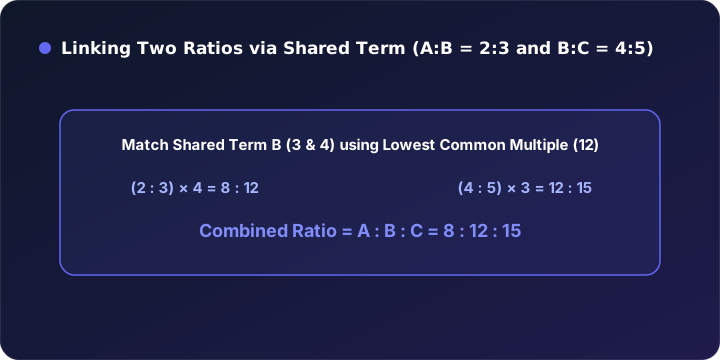
| Combined | Two linked ratios | A:B = 2:3 and B:C = 4:5 gives A:B:C = 8:12:15 |
These last five examples complete your 10 step-by-step ratio solutions.
How Should You Approach Ratio Questions With Unfamiliar Real-World Situations?
Strip away the story. A problem about paint, planets, or pizza still follows the same math. Replace strange words with simple labels like “first thing” and “second thing.”
Then use your routine. Find the ratio, list known values, and identify the goal. Case study: Picture a student facing a problem about fertilizer mixed with water at 1:4. She rewrites it as “1 part A to 4 parts B.” Suddenly it looks like the juice problem she already solved.
Linking Two Ratios Into One
The combined problem above needs care. B appears as 3 in one ratio and 4 in the other. Make B the same in both by using 12. Multiply the first ratio by 4 and the second by 3. This method solves many multi-step ratio problems.
What Common Reading and Calculation Errors Affect Ratio Answers?
Reversing the order is the top mistake. If the problem says “girls to boys,” don’t write boys first. Another slip is dividing by one term instead of the total parts.
Calculation errors matter too. Rushing through multiplication causes wrong shares. Also watch for problems that compare part to whole instead of part to part. Rereading the question once more catches most of these errors.
Conclusion
Every ratio word problem follows the same path. Find the ratio, pull out the numbers, and confirm the question. Set up labels, simplify when possible, and check the answer against the story. Practice these 10 examples until the steps feel natural. Soon, you’ll solve ratio questions step by step with speed and confidence.