Ratio vs. Proportion vs. Rate: What's the Difference?
Understand the clear distinctions between ratios, proportions, and unit rates with real-world examples, unit checks, and problem clues.
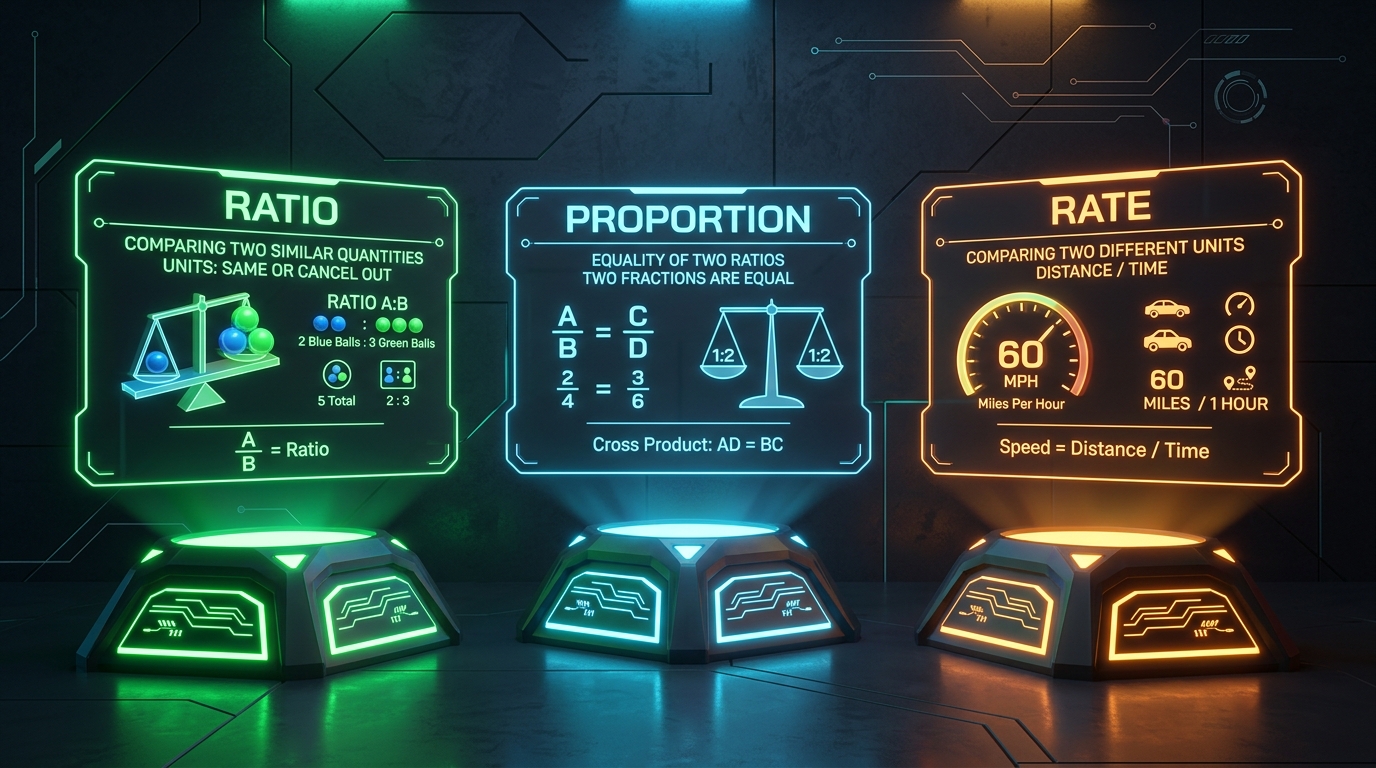
Ratios, proportions, and rates show up everywhere. They appear in recipes, road trips, and grocery aisles. Yet many students mix them up. That’s understandable, since all three compare numbers. This guide explains the difference between ratio proportion and rate in plain language. You’ll see clear examples, spot the key clues, and choose the right idea every time.
What Is a Ratio and What Does It Compare?
A ratio compares two or more quantities. It shows how much of one thing there is compared with another. You can write it as 3:5, 3 to 5, or 3/5.
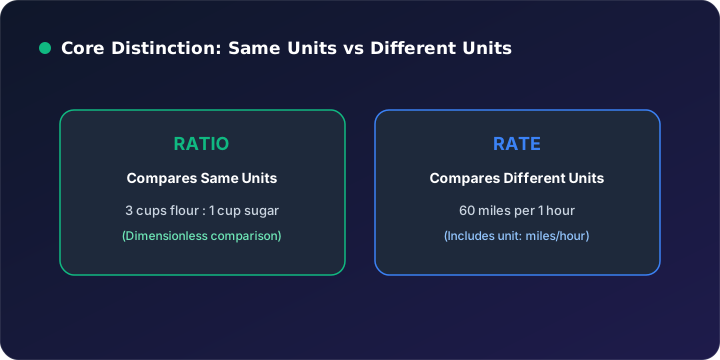
Ratios often compare things measured the same way. For example, 3 cups of flour to 1 cup of sugar. Or 12 girls to 18 boys. A mathematical ratio tells you about balance, not about totals.
What Is a Proportion and How Does It Relate to Ratios?
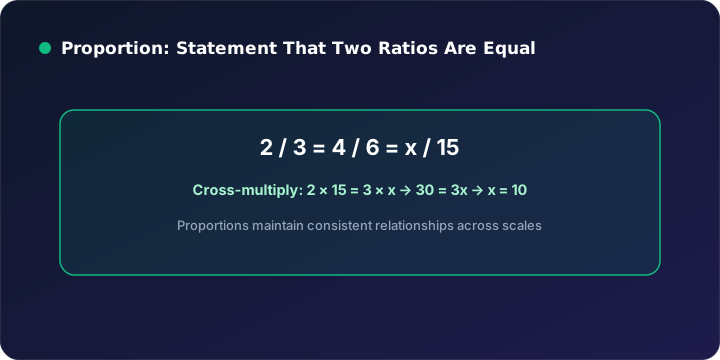
A proportion is a statement that two ratios are equal. For example, 2/3 = 4/6. Both ratios describe the same relationship, just at different sizes.
Proportions help you find missing values. If 2 cups of rice feed 3 people, how much feeds 6? You write 2/3 = x/6 and solve. The answer is 4 cups. That’s the power of a proportion equation.
Recognizing Equivalent Ratios in a Proportion
Equivalent ratios have the same simplified form. The ratios 4:6 and 10:15 both reduce to 2:3. So they form a true proportion. Checking this helps you recognize a proportion quickly.
What Is a Rate and How Is It Different From a Ratio?
A rate compares quantities with different units. Think miles per hour, dollars per pound, or words per minute. The units tell you what’s being measured.
A unit rate compares a quantity to exactly one of something. Driving 150 miles in 3 hours gives 50 miles per hour. Many textbooks call a rate a special kind of ratio. The difference lies mainly in those mixed units.
How Can Units Help You Distinguish a Rate From a Ratio?
Look at the labels. If both quantities share a unit, you likely have a ratio. If the units differ, you likely have a rate.
The table below makes the comparison clear.
| Concept | What It Does | Units | Example |
|---|---|---|---|
| Ratio | Compares quantities | Often the same | 3 cups flour : 1 cup sugar |
| Proportion | Sets two ratios equal | Matches the ratios | 2/3 = 4/6 |
| Rate | Compares different kinds of quantities | Different | 60 miles per hour |
| Unit rate | Rate per one unit | Different | $2.50 per pound |
When Should You Use a Proportion Instead of a Simple Ratio?
Use a ratio to describe a relationship. Use a proportion when you need to scale that relationship or find an unknown. Proportions are problem-solving tools.
For example, a map says 1 inch represents 25 miles. How far is 4 inches? Write 1/25 = 4/x. Solving gives 100 miles. Knowing when to use ratio or proportion saves you from extra work.
How Do Ratios, Proportions, and Rates Appear in Everyday Situations?
Ratios show up in cooking, like 2 parts water to 1 part rice. Rates show up in speed limits, gas prices, and hourly pay. Proportions show up when you enlarge photos or follow map scales.
Case study: Picture a teen planning a road trip. The car gets 30 miles per gallon, which is a rate. Gas costs $3.50 per gallon, another rate. To find the cost of 240 miles, she sets up a proportion. She needs 8 gallons, so the trip costs $28.
Spotting Real-World Rates When Shopping
Store shelf tags often list unit prices. A 16-ounce box for $4 costs $0.25 per ounce. Comparing these real-world rates helps you find the better deal quickly.
What Makes These Three Mathematical Concepts Easy to Confuse?
All three can be written as fractions. That shared look causes confusion. A fraction like 3/5 might be a ratio, part of a proportion, or even a rate.
Language adds to the mix-up. Words like “per” and “for every” appear in different problems. Also, many books say a rate is a type of ratio. So the ideas overlap. The trick is to ask what the numbers are doing.
How Can You Identify the Correct Concept From a Word Problem?
Ask three questions. Are two quantities being compared? That suggests a ratio. Are two ratios set equal to find a missing number? That’s a proportion. Do the quantities have different units? That’s a rate.
Clue words help too. “Per,” “each,” and “every hour” point to rates. “Is to” and “same as” hint at proportions. This routine helps you identify ratio proportion or rate in seconds.
What Happens When a Ratio Also Looks Like a Rate?
Some comparisons sit in the middle. Take a student-to-teacher ratio of 25:1. It’s often called a ratio. Yet it’s also read as 25 students per teacher, which sounds like a rate.
Don’t panic here. Both views can be correct. What matters is how you use it. If you’re scaling classrooms, treat it as a ratio. If you’re finding a per-unit amount, treat it as a rate. Context decides the label.
Using Context to Label Tricky Comparisons
Read the question’s goal. Is it asking for balance or for a per-unit value? That answer tells you which tool to reach for. This habit builds strong proportional reasoning.
Conclusion
A ratio compares quantities. A proportion says two ratios are equal. A rate compares quantities with different units, often per one unit. Check the units, look for clue words, and think about the question’s goal. With these simple tests, you can compare ratio proportion and rate confidently in class and in daily life.