How to Simplify Ratios With Decimals: A Clear Step-by-Step Guide
Simplify decimal ratios in two easy steps. Learn how to remove decimal points with powers of 10 and reduce whole numbers with GCF.

Decimals can make ratios look messy. A ratio like 1.5:2.5 isn’t easy to read at a glance. But it simplifies to a neat 3:5. This guide shows how to simplify ratios with decimals using two easy moves. You’ll learn to remove decimals, find common factors, and avoid slips that quietly change your answer.
What Does It Mean to Simplify a Ratio With Decimals?
Simplifying means writing a ratio in its smallest whole-number form. The relationship stays the same. Only the numbers get cleaner.
For decimal ratios, this takes two stages. First, turn decimals into whole numbers. Second, reduce those whole numbers. The result is a simplified ratio that’s easy to compare and use.
How Can You Remove Decimal Points From a Ratio?
Multiply both terms by the same power of 10. If the longest decimal has one place, multiply by 10. If it has two places, multiply by 100.
For example, 1.5:2.5 becomes 15:25 when multiplied by 10. Both terms moved together, so the ratio didn’t change. This is how you remove decimals from a ratio safely.
Choosing the Right Multiplier for Decimal Ratios
Count the digits after each decimal point. Use the largest count. One place means 10, two places mean 100, and three places mean 1,000. This rule helps you convert decimal ratio to whole numbers every time.

What Role Does Multiplication Play in Decimal Ratio Simplification?
Multiplication keeps ratios equivalent. When you multiply both terms by the same number, the balance stays fixed. That’s why it’s safe to use.
Think of it like zooming in on a map. Distances look bigger, but their relationship doesn’t change. In the same way, 0.3:0.9 and 3:9 describe the same comparison. Decimal multiplication simply makes the numbers easier to handle.
How Do You Find the Greatest Common Factor After Removing Decimals?
List the factors of both numbers. Find the largest one they share. That’s the greatest common factor, or GCF.
Take 15:25. The factors of 15 are 1, 3, 5, and 15. The factors of 25 are 1, 5, and 25. The GCF is 5. Dividing both terms by 5 gives 3:5. That’s the simplest form.
How Can You Simplify Ratios With Different Numbers of Decimal Places?
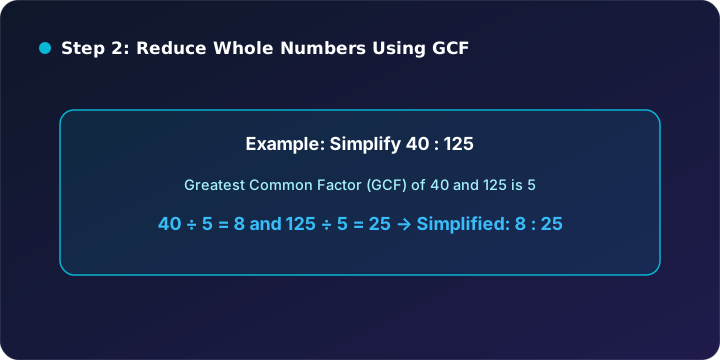
Use the multiplier for the longest decimal. Take 0.4:1.25. The second term has two places, so multiply both by 100. That gives 40:125.
Then find the GCF. Both numbers divide by 5, giving 8:25. The table below shows more examples.
| Decimal Ratio | Multiply By | Whole Numbers | Simplest Form |
|---|---|---|---|
| 1.5:2.5 | 10 | 15:25 | 3:5 |
| 0.4:1.25 | 100 | 40:125 | 8:25 |
| 0.6:0.9 | 10 | 6:9 | 2:3 |
| 2.25:0.75 | 100 | 225:75 | 3:1 |
How Do You Check Whether a Decimal Ratio Is Fully Simplified?
Check the GCF of your final terms. If it’s 1, you’re done. For 8:25, no number other than 1 divides both. So 8:25 is fully reduced.
You can also compare decimals. Divide the first term by the second in both ratios. For 0.4 ÷ 1.25 and 8 ÷ 25, both give 0.32. Matching values confirm your ratio lowest terms result.
A Quick Test for Lowest Terms
Try dividing both terms by 2, 3, and 5. If none works evenly, you’re likely finished. This fast check helps you reduce decimal ratio to lowest terms with confidence.
What Happens When the Decimal Values Have Different Place Values?
Mixed place values trip up many students. In 0.5:0.25, one term has tenths and the other has hundredths. Multiplying by 10 gives 5:2.5, which still has a decimal.
That’s why you must use 100 here. Then 0.5:0.25 becomes 50:25. Dividing by 25 gives 2:1. Case study: Picture a student comparing 0.5 liters of juice to 0.25 liters of syrup. After using the right multiplier, she sees the drink is 2 parts juice to 1 part syrup.
How Should You Handle Very Small or Very Large Decimal Ratios?
Very small decimals need bigger multipliers. Take 0.004:0.006. Three decimal places call for 1,000. That gives 4:6, which simplifies to 2:3.
Large decimals follow the same rules. Take 120.5:241. Multiply by 10 to get 1205:2410. Since 2410 is exactly twice 1205, the ratio is 1:2. Always look for simple patterns before listing factors.
Simplifying Ratios With Fractions and Decimals Together
Convert everything into one form first. Take 1/2 : 0.75. Change 1/2 to 0.5. Then multiply by 100 to get 50:75. Dividing by 25 gives 2:3. This helps you simplify a ratio with fractions and decimals smoothly.
What Common Decimal-Conversion Mistakes Can Change the Ratio?
The biggest mistake is multiplying only one term. If you turn 1.5:2.5 into 15:2.5, the ratio breaks. Always multiply both terms by the same number.
Another mistake is moving the decimal the wrong number of places. For example, 0.4 × 100 = 40, not 4. Some students also stop before fully reducing. Leaving 15:25 unsimplified isn’t wrong, but it isn’t the simplest form either.
Conclusion
Simplifying decimal ratios takes two clear steps. First, multiply both terms by the right power of 10 to remove decimals. Then divide by the greatest common factor. Use the longest decimal to choose your multiplier, and always check your final answer. With these habits, you’ll reduce a decimal ratio quickly and correctly every time.